
The release of DeepSeek R1 at the start of the year sent shockwaves through the global AI industry, proving that China could develop advanced, high-performing models at a fraction of the cost of Western competitors – despite U.S. export controls and resource constraints. This breakthrough challenged assumptions about the scalability, economics, and accessibility of state-of-the-art AI, and triggered reevaluations among investors, tech firms, and policymakers worldwide.
Given these dramatic shifts, we have been trying to better understand AI developments in China. We also wanted to understand the broader impact of these developments on other sectors and companies. So I recently joined an AI- and robotics-themed trip organised by Tech Buzz China to Shanghai and Hangzhou. On the trip, I met several Chinese AI unicorns along with other AI and robotics startups.
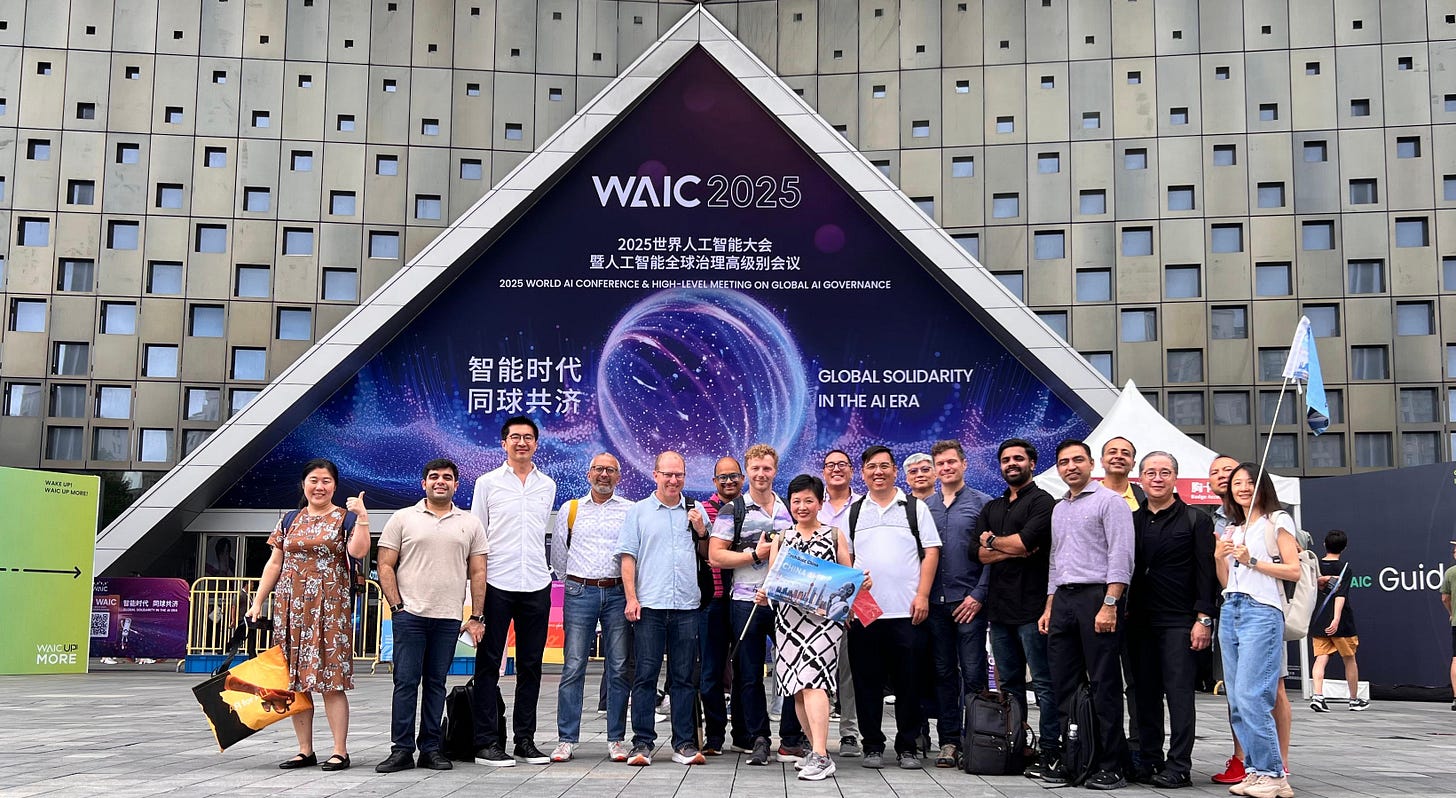
We think the Western media is underestimating the pace of AI development in China. China is catching up and pulling ahead in AI development. The Chinese government is pushing hard to streamline AI and Robotics development through significant incentives. In the US, a key bottleneck in building AI data centers is power which is not an issue in China (see following chart).
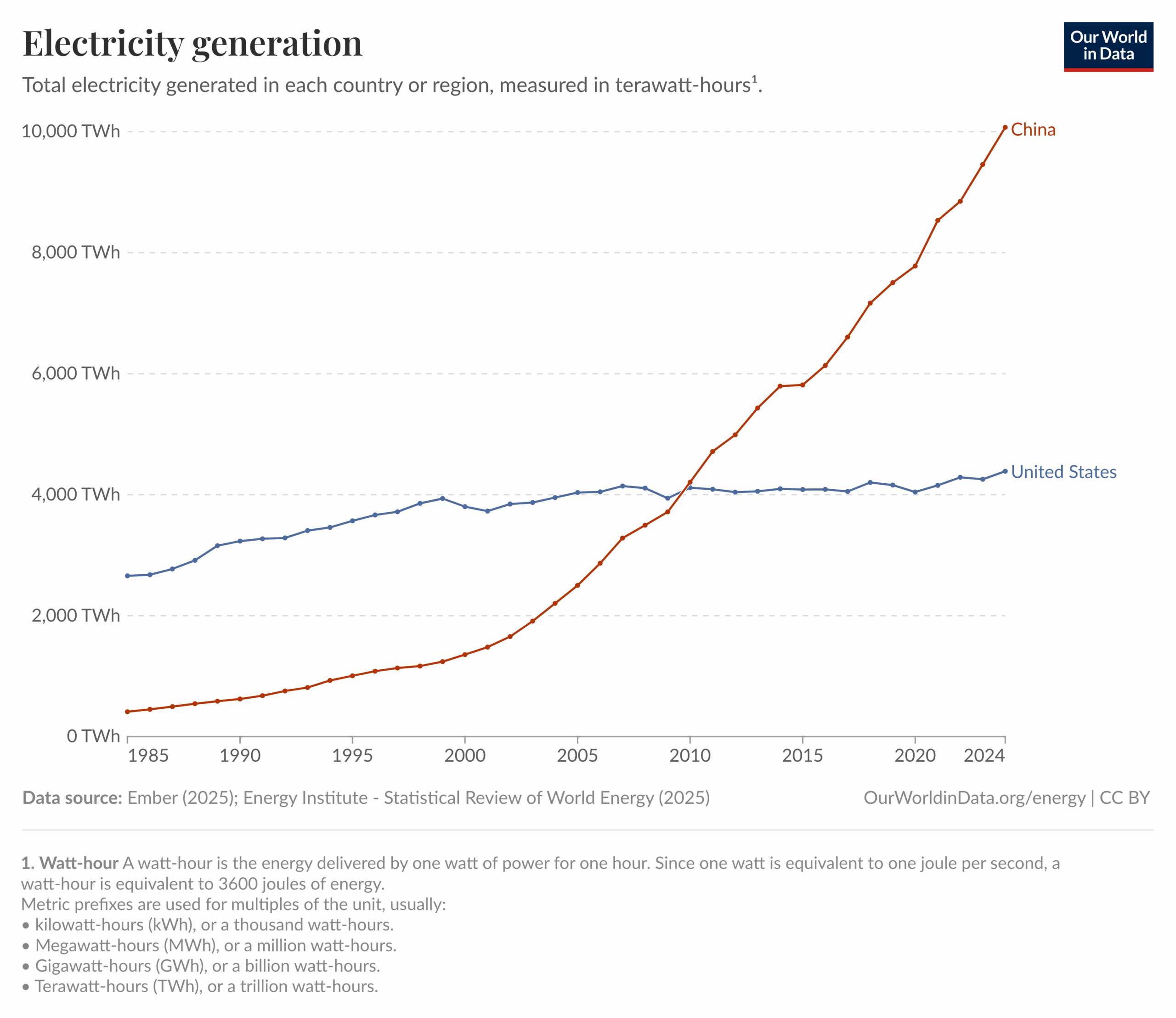
As the chart shows, America’s electricity generation was already slowing but it almost flatlined after 2010 to just 8 basis points y/y growth! Meanwhile, in the same period, China’s electricity generation increased at a pace of 4.1% annually. The net result is that China generates more than twice the electricity than the U.S. now…and it has the know-how to rapidly scale up its power generation infrastructure. This has become a key advantage to feed the power-hungry AI data centers.
A striking trend throughout our trip was the acceleration of open-source development as a cornerstone of China’s AI strategy. Companies like DeepSeek and Alibaba are releasing powerful models under open licenses, fostering rapid innovation, lowering adoption barriers, and cultivating thriving developer communities within and beyond China’s borders. This open approach is enabling these firms to outpace traditional, closed-model peers in acceptance and ecosystem growth.
Confronting the reality of ongoing U.S. export controls on advanced chips, Chinese AI companies have responded with ingenuity. By pursuing architectural innovations and emphasizing algorithmic optimization, industry leaders minimize their need for top-tier semiconductors. Domestic efforts, such as Huawei’s development of homegrown GPUs, underscore a broader push toward technological autonomy.
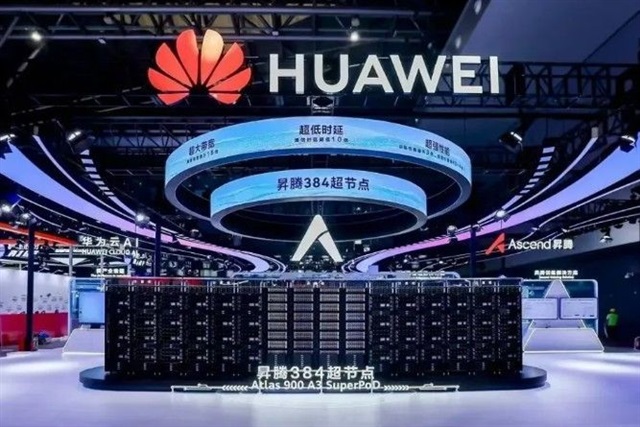
At the World AI Conference (WAIC) in Shanghai, Huawei showcased its latest CloudMatrix 384 system. Industry analysts view it as a direct competitor to Nvidia’s GB200, the U.S. chipmaker’s most advanced system-level product currently available in the market. Huawei still has a long way to go to catch up with nVidia and AMD. However, by restricting sales of advanced chips to China, the U.S. government has given China a strong incentive to develop homegrown alternatives.
Where Chinese companies truly shine is in the realm of applied AI. Robotics, autonomous vehicles, and sector-specific solutions dominated our meetings, with local players successfully integrating cutting-edge AI into tangible products for manufacturing, logistics, and consumer use. The focus on delivering practical, bottom-line value to end-users marks a noteworthy contrast with Western markets where experimentation and academic benchmarks often take precedence.
Notably, the prevailing attitude among founders and executives was pragmatic. Conversations were centered not on distant existential questions or speculative risks, but on innovation that drives immediate business outcomes. Most of the founders we met saw AI as a tool with which they could solve real-world challenges for partners and customers today.
China’s close-knit manufacturing and innovation ecosystem stand as a powerful enabler of this momentum. This is particularly visible in the robotics sector. Proximity to advanced factories and supplier networks enables teams to iterate at a high speed, translating lab breakthroughs into commercial deployments in weeks rather than months. This tight integration of R&D and manufacturing is a critical competitive edge unique to the region.
One example of this was Hangzhou based Fancy Tech which aims to “make anyone’s idea become a popular sellable product globally – in just one week”! Fancy Tech is moving far beyond its original e-commerce marketing roots by embedding itself directly within the manufacturing supply chain. Leveraging its proximity to China’s dense network of factories and suppliers, the company is now integrating its AI-driven solutions with core manufacturing processes—a feat that would be difficult for non-Chinese competitors to replicate due to the unique regional infrastructure.
Lastly, the organizations we visited displayed an impressive level of operational efficiency. Many of these AI startups run exceptionally lean. They are leveraging AI not just in the products they build, but across internal functions: coding, design, marketing, and even research are often turbocharged by automation and intelligent workflows. Though impressive, this is also a worrying sign as these AI tools will lead to significant job losses in multiple industries. We are already seeing early signs of job losses in the traditional IT sector as well as large technology companies which were early to adopt AI coding tools.
Our China trip revealed an AI ecosystem that has moved beyond the “imitation” phase to become a genuine innovation center with distinct competitive advantages. The traditional binary view of U.S. technological dominance versus Chinese catch-up is inaccurate. The combination of state support, cost-efficient engineering, and rapid commercialisation capabilities positions Chinese AI companies as formidable global competitors. For us, this represents both an opportunity to invest in innovative technologies at attractive valuations and a necessity to understand the evolving competitive landscape in one of technology’s most important sectors.
As a general-purpose technology, AI will pervasively transform how businesses operate, compete, and create value across virtually every sector. To successfully navigate this trend, we must identify which established business models are vulnerable to AI-driven creative destruction and where new value creation opportunities will emerge.